

Why Romance is Basically Sci-Fi
Suspending disbelief in the name of love

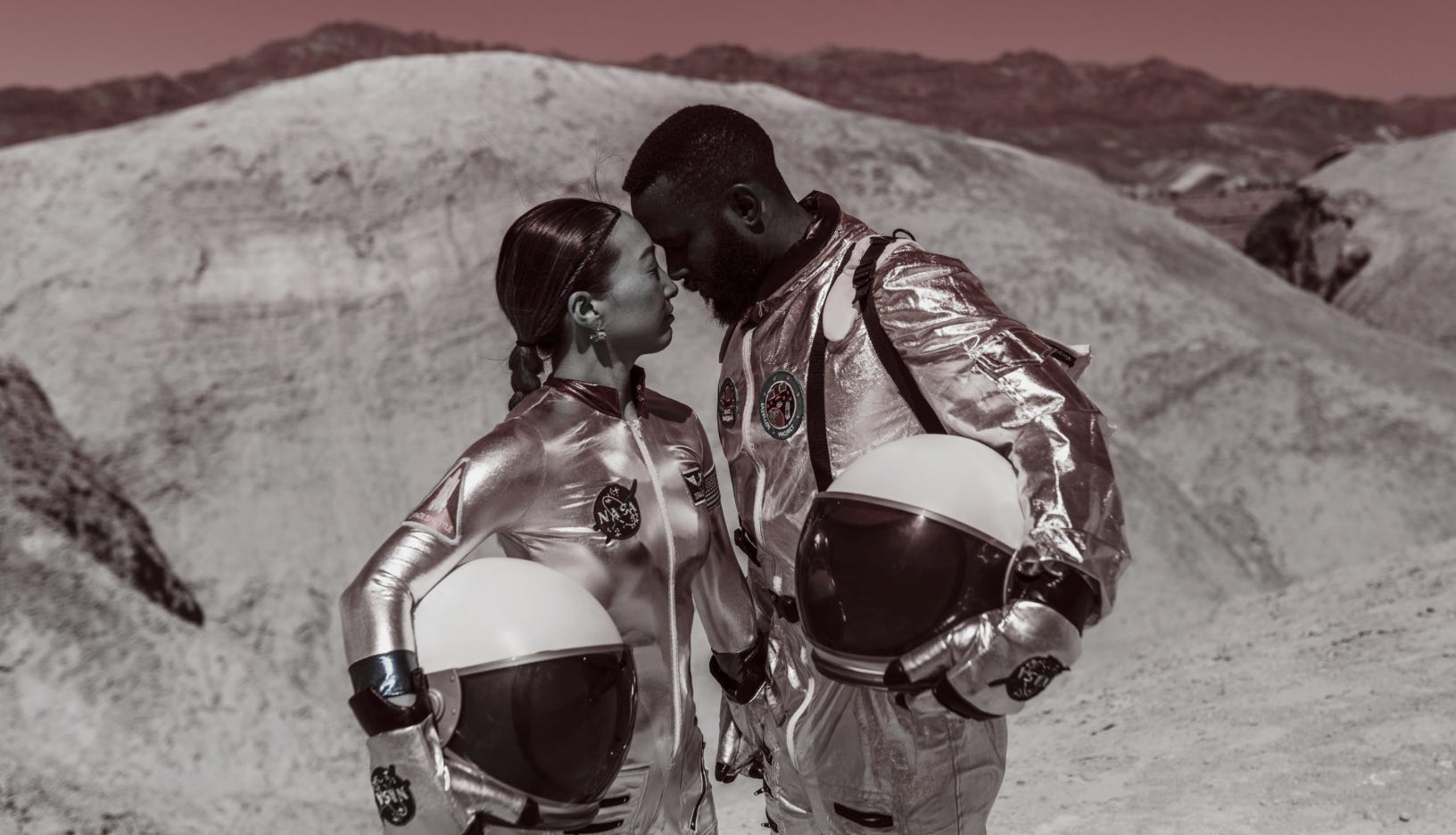
What do Christopher Nolan’s Interstellar and the Adam Sandler rom-com, The Wedding Singer, have in common?
At first glance… nothing.
Interstellar is a sci-fi film about quantum physics, relativity, and the struggle to save humanity from a bleak and inhospitable Earth in the year 2067.
The Wedding Singer is a truly goofy romantic comedy about a down-and-out wedding singer who falls for a waitress, set against the nostalgic and neon-drenched backdrop of the 1980s.
These two movies should not share DNA.
But they do.
Both Interstellar (sci-fi) and The Wedding Singer (rom-com) are built upon one very distinctive, thematic idea: the belief that love transcends logic.
Therein lies the vital intersection between science fiction and romance, two genres built on the architecture of wishful thinking, whose foundation is forged in hope.
Science fiction asks: “What if humans could bend the laws of the Universe?”Romance asks: “What if love could bend human behavior?” Both genres ask readers and viewers to believe in something wildly irrational.
To quote Mindy Kaling:
“I simply regard romantic comedies as a sub-genre of sci-fi, in which the world created therein has different rules than my regular human world… For me, there is no difference between Ripley from “Alien” and any Katherine Heigl character. They are equally implausible”.
Both genres, science fiction and romance, are equally improbable, and yet, fans continue to show up and nerd out on their behalf. But… why? Why do readers and movie-goers continue to show up for two storytelling genres that everyone largely agrees are unrealistic to the point of ridiculous?
Perhaps it’s because sci-fi and romance suggest even improbable things are worth believing in, worth celebrating, and worth fighting for.
For many people today, finding love in the real world versus on a dating app feels as improbable as Matthew McConaughey surviving time travel by being sucked into a black hole. Yet, that improbability doesn’t stop people from continuing to put themselves out there in the hopes that they will find love, just as scientists continue to hunt for solutions to the world’s problems and the mysteries of the Universe.
Our favorite love stories and cosmic odysseys require faith in insurmountable odds, an earnest suspension of disbelief, and the hope that with enough courage and sheer will, there is a way through anything.
Interstellar and The Wedding Singer may not exist on the same shelf at the no-longer-in-existence movie rental store, but both ask their characters:
“How far are you willing to go for love? What are you willing to sacrifice?”
For Matthew McConaughey’s character, Cooper, in Interstellar, the answer is… everything. The chance to watch his children grow up, his own life, everything. There is nothing he would not do for love.
Adam Sandler’s character, Robbie, in The Wedding Singer, is willing to sacrifice his own happiness for Drew Barrymore’s character, Julia, to find hers. Perhaps it’s a sacrifice on a smaller scale, but it is no less profound.
The Improbability of Romance
The improbability of the romance genre isn’t that two people falling in love is some impossible construct. People fall in love every day. We know love is possible.
What’s improbable, especially in the world of Hallmark, is how quickly and effortlessly people fall in love. It’s the idea that the high-powered and incredibly busy corporate lawyer can drop everything to help save some random guy’s Christmas farm in some random small town she’s conveniently been stranded in.
In these movies, and in some romance novels, the witty banter flows effortlessly, no one gets their period, and the combined forces of love and Christmas somehow always prevail. Even when our two leads have only known one another for a grand total of 8-10 days (roughly the length of a film’s shooting schedule.)
Watching a Hallmark movie feels as surreal as a movie about space-time wormholes. The logic of the Hallmark universe bend as easily as time in Intersetellar. And perhaps that’s why we can’t get enough of Hallmark-type romance.
We KNOW it’s ridiculous. We KNOW how it’s going to end. WE KNOW. But we’d rather watch a ridiculously far-fetched romance and buy into the idea that love really does find you in the most unlikely of places than invest in overly rational, real-life stories.
We’re all currently living “real life,” which, if we’re being honest, increasingly feels like some Matrix simulation. And because I am living in this current reality, I am more than happy to suspend all disbelief and watch a science fiction movie in which hope, faith, and Matthew McConaughay win — just as I’m willing to watch yet another Hallmark movie in which the town’s only baker looks like he’d be more at home dirty dancing in a Magic Mike film than needing sourdough.
Another reason Hallmark romances feel as unreal as science fiction is that we currently live in a time of irony, cynicism, and insincerity. Thus, the very idea that something earnest and heartfelt could exist feels out of place.
Yes, Hallmark movies are cheesy, and often quite “cringe,” in part because of their overly sincere tone… in part because of the low budgets and bad casting. But maybe their improbability has less to do with the actual romances themselves and more to do with our society being out of step. In a world that prizes sarcasm over sincerity, maybe stories of hope, love, and unabashed optimism are a tiny little miracle. In the same way that the unrelenting force of a father’s love can bend the laws of the Universe to ensure humanity's survival (Interstellar).
If romance and science fiction are siblings, sired by hope and determination, then writing romance is rather visionary, and reading romance is an exercise of both the imagination and one’s human potential.